
If you notice your heat pump freezing up in winter, look at the pattern rather than searching for one magic temperature or ice measurement. A light, even-looking frost that later clears while normal heating returns can be part of winter operation. Ice that remains, spreads, repeatedly returns, or blocks the coil or fan area needs professional assessment. Visible frost or ice alone is usually an HVAC question, not automatically a 911 emergency.
Emergency first: If a CO alarm sounds or you suspect carbon monoxide exposure, move everyone outside to fresh air, call 911, and do not reenter until emergency responders permit it, as directed by the U.S. Consumer Product Safety Commission. If you smell gas, leave without using switches, phones, or electronics indoors; from outside, call 911 and the gas utility, following Oklahoma Natural Gas safety guidance. For smoke, visible fire, sparking, or an immediate shock hazard, leave the area and call 911.
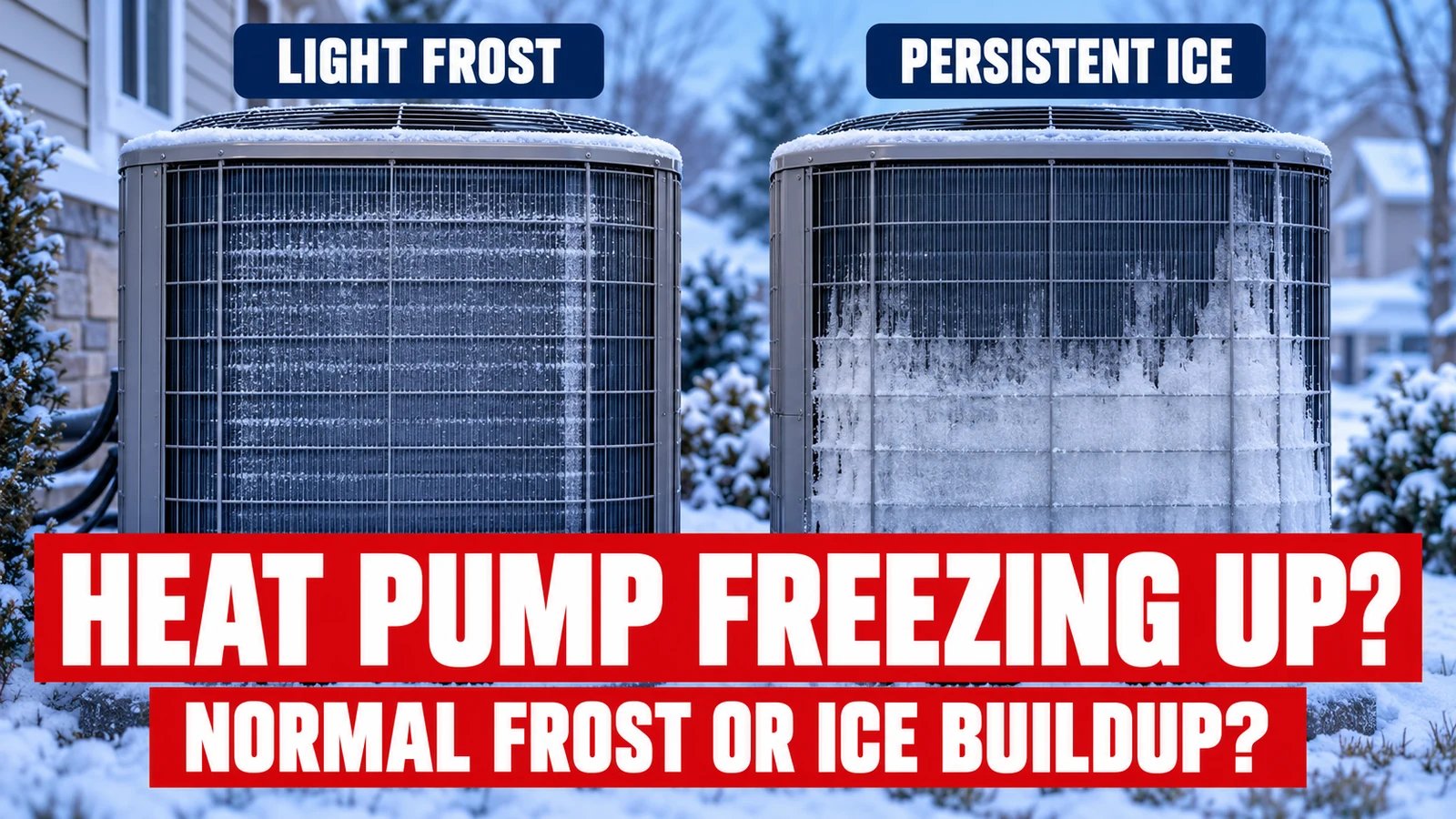
Normal frost vs. ice buildup: what to look for
No photograph can identify a failed part, but visible changes over time can help you choose the right next step.
| What you observe | What it means for your next step |
|---|---|
| Thin or light-looking frost that later clears, with normal heating returning | This can fit ordinary winter operation. Continue to observe without touching the unit. |
| Temporary mist or steam, water, a sound change, or different outdoor-fan behavior while frost appears to clear, followed by normal heating | These signs can occur during automatic defrost, but they do not prove that every part is working correctly. |
| Persistent, spreading, solid, or repeatedly returning ice; an obstructed coil or fan area; falling indoor temperature; or unusual mechanical noise | Keep away from moving parts and arrange professional assessment. |
| Smoke, fire, sparking, an immediate shock hazard, a CO alarm, or gas odor | Treat the hazard as an emergency and follow the leave-and-call guidance above. Do not continue HVAC troubleshooting. |
Carrier’s homeowner guidance similarly distinguishes light frost that clears during defrost from solid or persistent ice that needs attention. The distinction is about how the frost behaves—not a universal thickness, clock time, or outdoor temperature.
Why frost forms on a heat pump in winter
In heating mode, the outdoor coil gathers heat from the outdoor air and transfers that heat indoors. Moisture can collect and freeze on the cold coil surface, especially during cold, damp conditions. That is why some frost on the outdoor unit does not automatically mean the heat pump has failed.
Heat pumps are designed to remove frost from the outdoor coil. U.S. Department of Energy and NREL research describes reverse-cycle defrost as a common way systems do this. The details depend on the equipment, its controls, installation, and current conditions, so a nearby air-temperature reading cannot tell you exactly when a particular system should defrost.
The important question is whether the unit appears to clear the frost and resume normal heating. A heat pump covered in ice that keeps growing or remains in place is a different pattern from a light coating that later disappears.
What automatic defrost can look like
The heat pump’s own controls initiate defrost when the system determines it is needed. From a safe distance, you may notice mist or steam near the outdoor unit, water below it, a change in sound, or different outdoor-fan behavior. Trane’s explanation of heat-pump defrost confirms that visible steam can occur as frost melts. These observations may fit a defrost cycle, but none is proof by itself.
Afterward, the coil should look clearer and normal heating should return. There is no single trigger temperature, interval, duration, or number of cycles that applies across all heat pumps. Use the equipment’s normal user instructions, and arrange service if ice persists or the home continues losing heat.
If your main concern is air temperature at the vents, use the separate guide to a heat pump blowing cold air. If the thermostat displays a backup-heating label, the guide to AUX heat and Emergency Heat explains that distinction. Do not select Emergency Heat merely as a thawing test.
Safe checks before you call
Keep your checks limited to ordinary controls and visible conditions. You are collecting useful information for a technician, not trying to identify the failed component.
-
Start indoors. Note the thermostat’s visible mode, setpoint, displayed status, and current room temperature. Watch whether the indoor temperature is rising, holding, or falling. Use only normal homeowner controls. If the display or controls themselves are the issue, follow these safe thermostat checks instead of expanding the outdoor-unit troubleshooting.
-
Check routine airflow items. If the filter is normally homeowner-accessible, look at it and follow the equipment manufacturer’s instructions. Do not apply one replacement interval to every home or system. Make sure ordinary supply registers and returns have not been covered by furniture, rugs, or stored items.
-
Observe outdoors from a safe distance. Stay on dry, stable ground. Note whether the frost looks light and is clearing or whether ice remains, spreads, or obstructs an airflow area. Listen for grinding, striking, scraping, or struggling sounds without approaching the fan. A photo taken from a safe position can help show how the condition changed.
-
Look at the surroundings. ENERGY STAR guidance identifies outdoor snow and debris as airflow concerns. If you can do so safely without touching the equipment, move only loose leaves or loose snow from the surrounding ground. Do not reach into the unit. Also note visible roof runoff, a leaking gutter, or water refreezing near the equipment; ENERGY STAR’s ductless outdoor-unit siting guidance treats defrost water and roof runoff as installation considerations. Because that guidance is specific to ductless installations, use the observation only as a visual clue to report—not as a universal diagnosis or an instruction to modify drainage, gutters, pads, or equipment.
What not to do to a frozen heat pump
Even when the heat pump ice buildup looks reachable, trying to speed up thawing can damage the coil, fan, controls, or other parts.
- Do not chip, scrape, pry, break, or pull ice from the unit.
- Do not pour hot or warm water on it, spray it, or use a hair dryer, heat gun, torch, space heater, or any other external heat source.
- Do not force a defrost cycle, repeatedly reset the equipment, select Emergency Heat as a generic test, or enter installer or dealer controls.
- Do not remove panels, open a disconnect, touch wiring, reach near fan blades, handle refrigerant lines, or attempt refrigerant, valve, sensor, or control work.
Carrier explicitly warns homeowners not to chip ice from the coil, while Lennox’s frozen-heat-pump guidance also warns against breaking ice or pouring hot water on the equipment. There is no substitute DIY thawing method to recommend here. If a fan appears to strike ice, the unit makes grinding noises, or you see damage, keep away and arrange service.
When ice buildup needs professional service
Request an assessment when any of these patterns appears:
- Frost or ice does not clear, continues spreading, or quickly returns after appearing to clear.
- A solid coating covers the coil or ice obstructs the fan area.
- The indoor temperature is falling or the system is not recovering toward its setpoint.
- The outdoor unit makes grinding, striking, scraping, or struggling sounds.
- An alert repeats, the fan appears obstructed, or visible damage is present.
A technician may evaluate indoor and outdoor airflow, drainage or refreezing conditions, defrost sensors and controls, outdoor-fan operation, and the refrigerant circuit. Those are diagnostic categories, not conclusions that can be drawn from the shape of the ice. Testing controls or refrigerant requires the proper training and equipment.
Use Capehart’s professional heat pump service page to request an on-site assessment. When you call, describe when the ice appeared, whether it ever cleared, how the indoor temperature changed, any unusual sound, and any visible obstruction or runoff. If loss of heat could make the home unsafe for an infant, older adult, or medically vulnerable person, move to a safely heated location while arranging appropriate help.
Heat pump service in Kiefer and Greater Tulsa
Capehart Heating & Cooling is based in Kiefer and serves the greater Tulsa area. Capehart offers 24/7 HVAC service. The $99 service-call fee covers the assessment visit only; all further work is quoted individually.
For urgent HVAC help that does not involve fire, gas, CO, or another life-safety hazard, use Capehart’s 24/7 HVAC service route or call 918-771-1218. For a non-emergency visit, schedule heat pump service and share the observations you collected. Online scheduling does not guarantee a particular time or immediate availability.
Frequently asked questions
Is frost on a heat pump normal in winter?
It can be. A light-looking layer that later clears while normal heating returns can fit ordinary operation. Solid, spreading, airflow-blocking, or persistent ice needs professional assessment.
Why does a heat pump keep freezing up?
Recurring ice can be associated with restricted airflow, runoff or refreezing, fan operation, defrost controls or sensors, or the refrigerant circuit. A technician must evaluate the system; the ice pattern alone cannot identify the cause.
At what temperature does a heat pump defrost?
There is no universal trigger temperature across equipment. Defrost logic varies by model, controls, installation, and conditions, so follow the owner’s manual and seek service if frost does not clear.
Can I pour hot water on a frozen heat pump?
No. Do not pour water on the unit or use tools or external heat to remove ice. Those methods can damage equipment and create additional hazards.
Should I use Emergency Heat when the heat pump is iced over?
Do not select Emergency Heat as a generic thawing or diagnostic test. Follow your equipment instructions or a technician’s direction; the linked AUX-versus-Emergency guide above explains the modes in more detail.