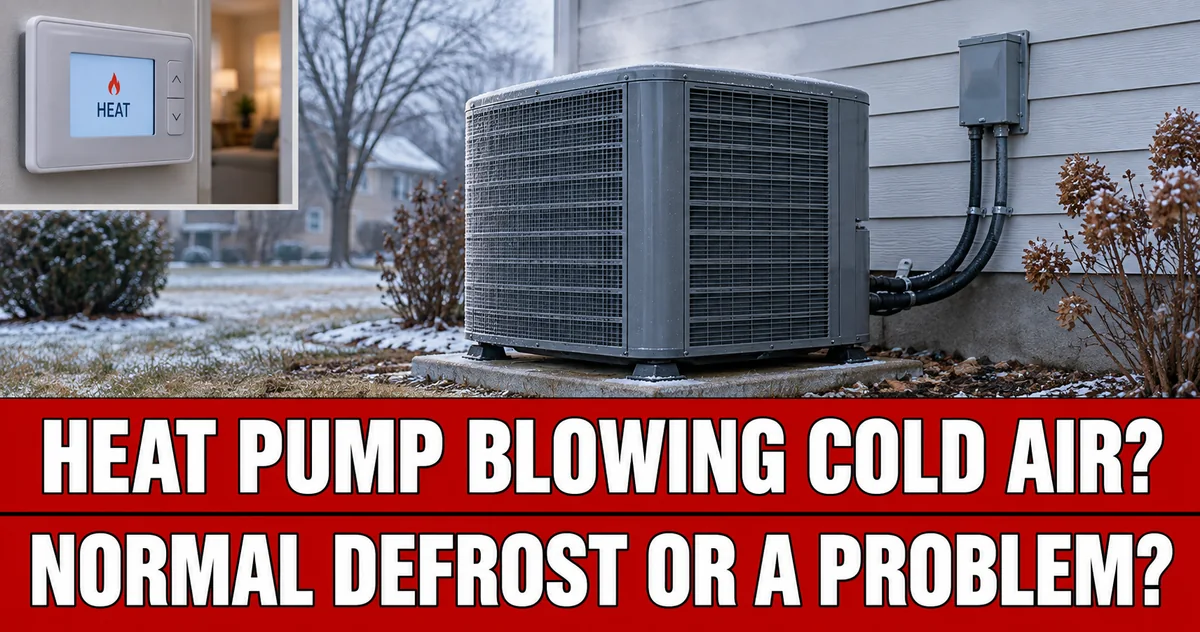
A heat pump blowing cold air in heat mode does not always mean the system has failed. Heat-pump air can feel less hot than furnace air, and some systems temporarily change the air delivered indoors during defrost. The better test is whether the home holds or moves toward its thermostat setting. Ongoing cold airflow, falling indoor temperature, heat that does not return, persistent ice, or unusual operation warrants professional assessment.
The U.S. Department of Energy explains that heat pumps transfer heat rather than produce it through combustion. That operating difference helps explain why normal heat-pump output may feel mild at a register. Visible observations can reveal a pattern, but they cannot identify a failed part.
Heat pump blowing cold air: normal, check, or call?
Ask whether the room is approaching the setpoint and whether normal heating returns after a temporary change. Those answers matter more than one burst of air.
| What you notice | What it may mean | Safe next step |
|---|---|---|
| Air feels mildly warm; the room holds or approaches the setpoint | The heat pump may be heating normally | Watch the indoor temperature trend |
| Air changes temporarily during apparent defrost, then normal heat returns | The system may be clearing outdoor-coil frost | Note the pattern once |
| Thermostat is not on HEAT, fan shows ON, or a schedule or hold is active | A setting may be affecting comfort | Review visible controls and owner instructions |
| An accessible filter appears overdue, or a grille is blocked | Airflow may be restricted | Follow model instructions and clear ordinary obstructions |
| Air stays cold while the indoor temperature falls | The home is not receiving enough heat | Request professional diagnosis |
| Heating does not return, ice persists, or operation repeatedly seems abnormal | The system needs evaluation | Keep away and request service |
The table sorts symptoms; it does not diagnose equipment. Any observation can be a clue without proving the cause.
Why heat-pump air can feel cool even when the home is heating
A heat pump can add heat to a room without producing the intense register air many people associate with a gas furnace. Moving air also feels cooler against skin than still air. That is why a hand held over a supply register is a poor pass-or-fail test.
Trane’s heat-pump guidance likewise distinguishes cooler-feeling heat-pump output from a system that is not warming the home. Check the trend shown by the thermostat and the comfort in the room over the operating cycle. If the indoor temperature holds or rises toward the requested setting, mildly warm airflow may be normal. If the home keeps cooling, the symptom belongs in the call category.
First confirm which equipment is supplying the air. If the home uses a furnace rather than a heat pump, follow the separate furnace blowing cold air guide. Furnace ignition and fuel-system issues are outside the scope of this heat-pump guide.
A defrost cycle can temporarily change the air you feel
Frost can form on the outdoor coil during heating. A heat pump may temporarily change its operation to clear that frost, and this defrost cycle can alter indoor airflow or make the air feel cooler. Depending on the equipment, its controls, and the installed backup heat, supplemental heat may temper the change—or the change may be more noticeable.
Carrier’s homeowner troubleshooting guidance describes cooler indoor air during defrost as a temporary condition and routes ongoing problems to professional service. There is no single defrost sequence or duration that applies to every system.
From a safe distance, you may notice a change in outdoor sound or fan behavior, water near the unit, or vapor that looks like mist. Those observations can fit defrost, but none confirms it remotely. What matters is whether ordinary heating returns and the home resumes moving toward the setpoint.
Do not chip or melt ice, spray the unit, touch refrigerant lines, remove a panel, or try to force defrost. Ice that remains, spreads, or returns with continued loss of heat needs an on-site assessment.
Safe checks before you call
Stay at normal user controls or the exterior of closed equipment. Renters and anyone who cannot safely reach a routine filter should stop at thermostat observations and contact the responsible property manager or service provider.
Confirm thermostat mode and fan setting
Confirm that the system mode reads HEAT and the requested temperature is reasonable. A fan set to ON can circulate room-temperature air between heating calls. Use AUTO where appropriate and follow the thermostat instructions. Do not make a large setpoint jump, repeatedly switch modes, enter installer settings, or reset equipment.
Review the schedule, hold, and visible status
Check the display or app for a schedule, vacation setting, hold, or visible alert. Read the model’s owner instructions before changing anything unfamiliar. If the controls are the main problem, use these safe thermostat troubleshooting checks rather than treating it as a heat-pump diagnosis.
Check routine airflow items
Look only at a filter routinely replaced without opening the air handler. Follow its marked direction and the equipment instructions; there is no universal replacement interval. Keep accessible supply registers and return grilles open and unobstructed.
A loaded filter or blocked grille does not explain every heat pump running but not heating. If the room keeps cooling, request professional testing.
Look at the outdoor unit from a safe distance
From a safe distance, note visible ice or an obvious obstruction. Move loose, ground-level material only if you can reach it without touching, climbing on, opening, spraying, or using tools on the unit.
Do not clean the coil, remove ice, handle a line or valve, open a disconnect, access wiring, or remove a panel. Stay away if the area is slippery, wet, damaged, or otherwise unsafe.
Record the pattern once
Write down the thermostat mode, setting, displayed indoor temperature, and whether that temperature is rising, holding, or falling. Note when the airflow changed, whether normal heat returned, any visible ice, and unusual sounds or odors. One clear description is more useful than repeated test cycles.
When continuing cold air needs professional diagnosis
Request HVAC service when cold airflow continues and the home does not recover toward the setpoint. Other call triggers include heating that never resumes after a temporary defrost-like change, ice that remains or expands, a repeating alert, or a new sound or odor. These patterns show that the system needs evaluation; they do not reveal which part is responsible.
A technician may evaluate thermostat communication and staging, defrost sensors and controls, airflow and duct distribution, outdoor-unit operation, backup heat, the refrigerant circuit, the reversing valve, or the compressor. Several categories can create similar symptoms, so cold air alone cannot separate them. Electrical testing, panel access, refrigerant work, valve manipulation, and internal cleaning belong to trained professionals.
Safety concerns take priority over an ordinary HVAC appointment. If a carbon monoxide alarm sounds, the U.S. Consumer Product Safety Commission says to move outside to fresh air, call emergency services from there, and remain outside until responders say it is safe. Do not search for the source first. A heat pump may be electric, but a home can have fuel-burning backup heat or other fuel-burning appliances.
For smoke, visible fire, sparking, scorching, or an immediate shock hazard, leave the area and call emergency services. If loss of heat could make conditions unsafe for an older adult, infant, or another vulnerable household member, move to a safely heated place while arranging appropriate help.
AUX heat and Emergency Heat are not the same
On equipped systems, AUX heat is supplemental heat that the controls may call automatically. Emergency Heat is a manual operating mode that generally relies on the installed backup configuration instead of normal primary heat-pump operation. Carrier’s AUX and Emergency Heat explanation notes that backup equipment and control behavior vary, with no universal AUX trigger for every system. An AUX display alone does not diagnose a fault. Do not turn on Emergency Heat as a generic test; follow the specific equipment instructions or a technician’s direction if the primary system is not heating.
What to tell the HVAC technician
A concise description can make the assessment more efficient. Report:
- The thermostat mode, setpoint, displayed status, and indoor temperature direction.
- Whether the home holds the setpoint and whether ordinary heat returns after the airflow changes.
- Visible frost, persistent ice, or an outdoor obstruction observed from a safe distance.
- Unusual sounds or odors, when they occur, and whether an alert repeats.
- The routine filter’s visible condition and the equipment model, if readable without opening anything.
- Any recent thermostat or HVAC work.
Do not open a cabinet to find a code, model label, or component.
Need heat-pump help in the greater Tulsa area?
Capehart Heating & Cooling is based in Kiefer and serves the greater Tulsa area. If the home keeps cooling or normal heat does not return, our heat pump repair and heating services team can assess the system. Capehart offers 24/7 HVAC service, with response and scheduling details confirmed when you contact us.
The $99 service-call fee covers the visit to assess the problem; it is not the repair price.
Heat pump blowing cold air FAQs
Is it normal for a heat pump to blow cool air in heat mode?
Sometimes. Heat-pump output may feel mild while it still adds heat to the room. Judge the pattern by whether the indoor temperature holds or moves toward the setpoint. Air that stays cold while the home loses warmth is not something to dismiss as normal.
Why does heat-pump air feel cooler than furnace air?
A heat pump transfers available heat instead of producing the intense output associated with furnace combustion. Its register air can therefore feel gentler, and moving air may feel cool against skin. Comfort and thermostat trend are better indicators than touch or a universal vent-temperature rule.
Can defrost make a heat pump blow cold air?
On some systems, defrost can temporarily change indoor airflow or make the delivered air feel cooler while the outdoor coil clears frost. The exact behavior depends on the equipment, controls, and backup heat. Ordinary heating should return; ongoing cold air or persistent ice needs service.
Should I turn on Emergency Heat?
Not as a general troubleshooting test. Emergency Heat is a manual mode whose operation depends on the installed backup system, and it is different from automatically controlled AUX heat. Follow the thermostat and equipment instructions or a technician’s direction when the primary heat pump is not heating.