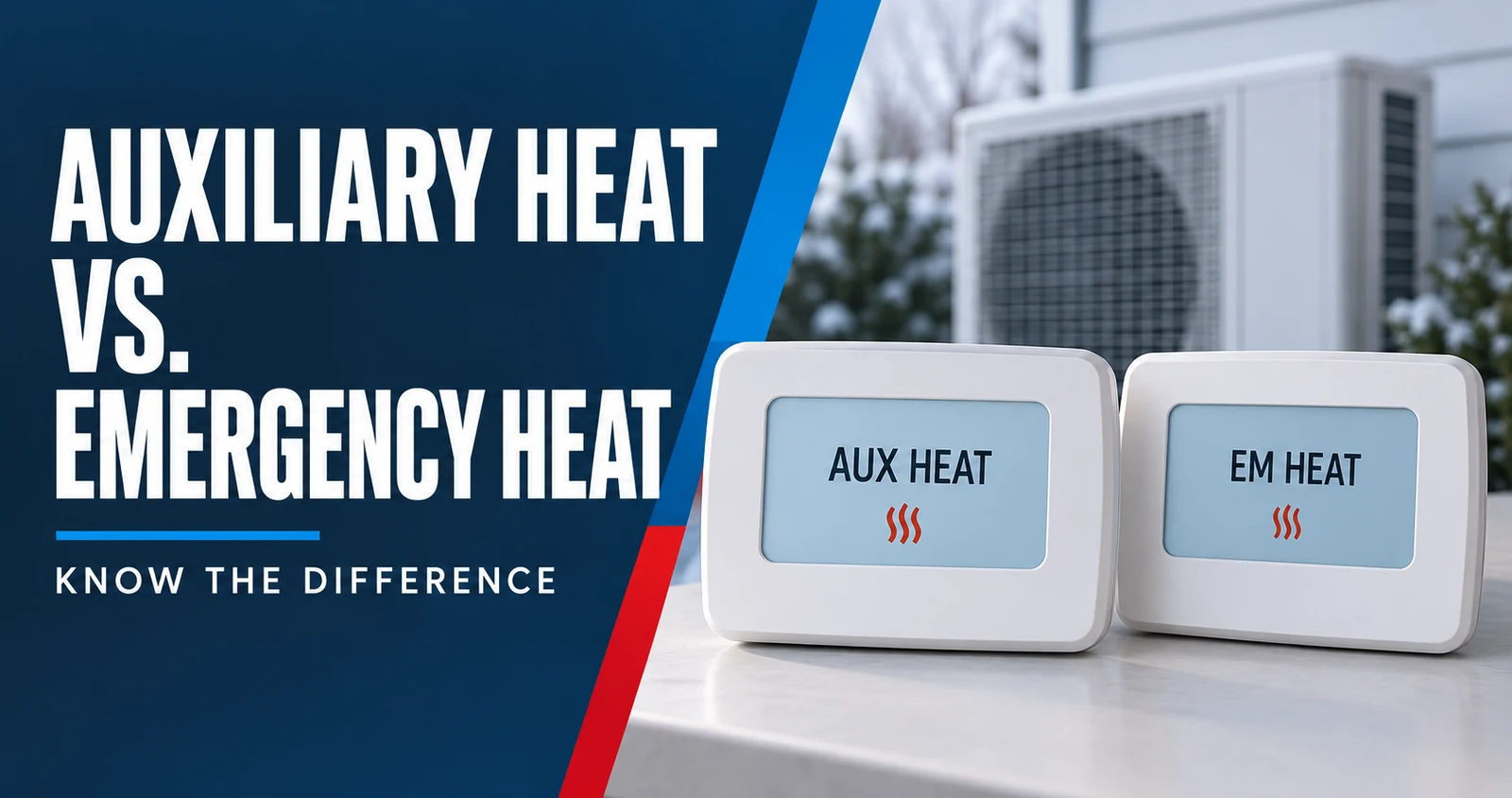
Auxiliary heat vs emergency heat comes down to control and purpose. Auxiliary heat, often shown as AUX, normally starts automatically when a heat pump needs help meeting the thermostat setting. Emergency Heat is generally a manual mode used when the heat pump itself should not run. On a typical setup, it locks out the outdoor heat pump and relies on the configured backup source. The exact labels and sequence depend on the thermostat, equipment, and installation, as guidance from Carrier and Resideo shows.
Seeing ‘AUX’ alone is not a reason to select Emergency Heat. Use that manual setting only when your thermostat instructions or an HVAC professional says the heat pump should not run.
Auxiliary Heat vs. Emergency Heat
Both terms refer to heat pump backup heat, but they do not describe the same operating choice. AUX is a stage the controls may call without any action from you. The emergency heat setting is a deliberate fallback. It is not an extra stage to add on top of normal heating, and it is not a “heat faster” button.
| Question | Auxiliary heat (AUX) | Emergency Heat (EM Heat) |
|---|---|---|
| Who activates it? | The thermostat or system controls, usually automatically | The homeowner or technician, usually through a manual mode selection |
| What may run? | Electric backup may supplement the heat pump; some dual-fuel controls switch to a furnace instead | The configured backup source runs while the outdoor heat pump is typically locked out |
| When is it normal? | During added heating demand, defrost, or recovery from a large setpoint change | When equipment-specific guidance or a professional says the heat pump should not operate |
| What does the label mean? | The system has called for supplemental or backup heat | The thermostat is set to rely on backup heat rather than normal heat-pump operation |
| What should you do? | Observe whether comfort returns; do not select Emergency Heat just because AUX appears | Follow the thermostat manual or professional direction and arrange service if the heat pump is not working |
| What is the likely cost effect? | Electric strips commonly use more electricity than normal heat-pump operation; dual-fuel cost varies | Cost depends on the backup source, runtime, utility rates, equipment, and controls |
That distinction is reliable, but the exact sequence is not universal. In the Resideo T10/T10+ configuration guide, electric backup can run with the heat pump, while a configured gas or oil furnace and the heat pump do not run together. A different thermostat or system may display stages differently. The label alone cannot identify your fuel type, wiring, or a failed part.
Why Auxiliary Heat Turns On
A heat pump moves heat from outdoors into the home. As outdoor conditions and the home’s heating demand change, the thermostat may call for backup capacity. Carrier’s auxiliary-heat guidance says that capacity, indoor and outdoor conditions, and thermostat controls all affect when AUX starts. That is why there is no universal 35- or 40-degree activation rule.
AUX can appear in several ordinary situations:
- Cold-weather demand: The home’s heat loss may temporarily exceed what the heat pump is supplying, so the controls add backup heat.
- Defrost: A heat pump periodically clears frost from its outdoor coil. On an electric-backup system, AUX may help maintain indoor comfort during that cycle. Trane’s defrost guidance notes that temporary steam or a stopped outdoor fan may also occur, although neither sight proves that every event is normal.
- Setpoint recovery: Raising the thermostat several degrees can create a larger heating call. Both Trane and Carrier identify recovery as a common time for supplemental heat.
Equipment size, the home’s heat loss, thermostat programming, and control settings can all change the pattern. Newer cold-climate models also have different low-temperature capabilities; ENERGY STAR advises that backup integration and system sizing should fit the home. None of these factors can be diagnosed from the AUX label alone.
Brief AUX operation that ends after recovery or defrost may be normal. If the concern is cool air from the vents rather than the thermostat label, see our guide to a heat pump blowing cold air.
When to Use Emergency Heat
Use Emergency Heat only as a temporary backup-only choice when the heat pump should not operate. That may be appropriate after an HVAC professional directs you to use it or when the equipment-specific thermostat instructions clearly call for it because the heat pump has failed. Carrier describes the mode as a manual setting that shuts off heat-pump operation while backup heat carries the load.
The Resideo T10/T10+ product guide provides a model-specific example: switching to Em Heat locks out the heat pump and uses backup heat to maintain the setpoint. Treat that as an example of configured behavior, not a universal instruction for every thermostat.
Do not select Emergency Heat simply because:
- AUX appears during normal heating.
- The weather turns cold.
- You raised the setpoint and want quicker recovery.
- You assume it is the most efficient mode.
If Emergency Heat appears when you did not select it, or you are unsure which mode your system uses, check the homeowner section of the thermostat manual or call an HVAC professional. Do not enter installer menus, change balance points, repeatedly switch modes, or open equipment panels.
Emergency Heat is also not a power disconnect or a life-safety control. A fire, gas odor, carbon monoxide alarm, smoke, or sparking requires the appropriate emergency response—not a thermostat-mode change.
What Backup Heat Costs
The cost effect depends first on what your backup source is. Electric resistance strips commonly draw more electricity than normal heat-pump operation. The U.S. Department of Energy recommends limiting unnecessary resistance-heat use and notes that heat-pump thermostats can manage recovery to reduce it.
A dual-fuel system is different. Its controls may switch from the heat pump to a gas or oil furnace rather than run electric strips. The cheaper choice cannot be named without knowing the equipment, fuel prices, electric rates, outdoor conditions, and control strategy. Trane likewise notes that furnace-backup operating cost depends on the fuel and system.
Avoid treating either AUX or Emergency Heat as a dollar figure. A steady or equipment-appropriate schedule may reduce unnecessary recovery calls on some systems, but it is not a universal promise of savings. For broader system context, compare common heat pump and furnace configurations.
An Oklahoma Cold Snap: What to Watch
Consider this hypothetical example. During an Oklahoma cold snap, a homeowner raises the setpoint several degrees after an overnight setback. AUX appears while the system works toward the new setting. The home reaches the target, and the AUX label goes away. That pattern could reflect normal recovery rather than a fault.
Later, the heat pump enters a brief defrost cycle. From a safe distance, the homeowner notices temporary steam near the outdoor unit and sees that the outdoor fan has stopped. Those signs may occur during defrost, according to Trane, but the homeowner does not touch the unit, chip ice, pour water on it, remove a panel, or attempt a reset.
Useful observations for a service call include:
- Whether conditions were colder or milder when AUX appeared.
- Whether the thermostat had just been raised and whether the home reached the setting.
- How often AUX appears and whether it goes away after recovery.
- Whether the pattern seems connected to defrost.
- Whether the outdoor unit appears to operate, viewed only from a safe distance.
The pattern matters more than a universal stopwatch. Arrange heat pump repair and assessment if AUX persists in mild conditions, the home cannot maintain temperature, unusual noise develops, heavy ice does not clear, the outdoor unit is not running when it normally should, a breaker trips, or energy use changes unexpectedly. These signs justify assessment; they do not identify a specific failed component.
If the display is blank or the controls do not respond, follow the separate guidance for when a thermostat is not working. Do not use thermostat Off or Emergency Heat as a substitute for electrical isolation, and do not attempt internal electrical, refrigerant, or combustion work.
Auxiliary and Emergency Heat FAQs
Is auxiliary heat normal?
Yes, it can be. AUX may appear during colder conditions, defrost, or recovery after a larger setpoint increase. If the home reaches its setting and AUX stops, that can be ordinary operation. Persistent AUX in mild weather or lost comfort deserves assessment.
When should I use Emergency Heat?
Use it when the heat pump should not operate and your thermostat instructions or an HVAC professional directs you to rely on backup heat. Do not select it for routine AUX operation, faster warmup, or as an everyday efficiency setting.
Does auxiliary heat cost more?
Electric resistance backup commonly uses more electricity than the heat pump alone. Dual-fuel cost is less predictable because equipment efficiency, fuel and electric rates, controls, and runtime all matter. The AUX label by itself cannot tell you the bill impact.
Why does AUX run during defrost?
Defrost temporarily clears frost from the outdoor coil. On some electric-backup systems, AUX may run to support indoor comfort during that cycle. Exact behavior varies, and persistent heavy ice or worsening defrost patterns should be checked professionally.
Can I turn off auxiliary heat?
Do not disable AUX or change installer settings on your own. AUX provides backup capacity as part of the system’s configured heating design. If it seems to run too often, document the pattern and ask a technician to evaluate the equipment and controls.
Emergency Safety and Local Heat Pump Help
AUX and Emergency Heat are thermostat terms, not emergency detectors. For a sounding CO alarm, the U.S. Consumer Product Safety Commission says to move outside, call emergency services, and stay out until authorities permit re-entry. If you smell gas, do not use phones or switches, and do not operate anything near the suspected leak before leaving. Leave first, then call 911 and your gas utility from outside; customers in its territory can follow Oklahoma Natural Gas guidance. For smoke, fire, or sparking, leave and call 911 from outside as well.
Capehart Heating & Cooling is based in Kiefer and serves the greater Tulsa area with 24/7 HVAC service. The $99 service-call fee covers the visit to assess the problem; repairs are quoted separately.
Sources
- Carrier — What Is Auxiliary Heat? Definition, Meaning & How It Works
- Trane — What is Auxiliary Heat and How Does it Affect HVAC Performance?
- Trane — What Is a Heat Pump Defrost Cycle?
- Resideo — T10 & T10+ Pro Smart Thermostat Product Data
- U.S. Department of Energy — Purchasing Energy-Efficient Residential Air-Source Heat Pumps
- ENERGY STAR — Air-Source Heat Pumps
- U.S. Consumer Product Safety Commission — Carbon Monoxide Fact Sheet
- Oklahoma Natural Gas — When You Smell Gas