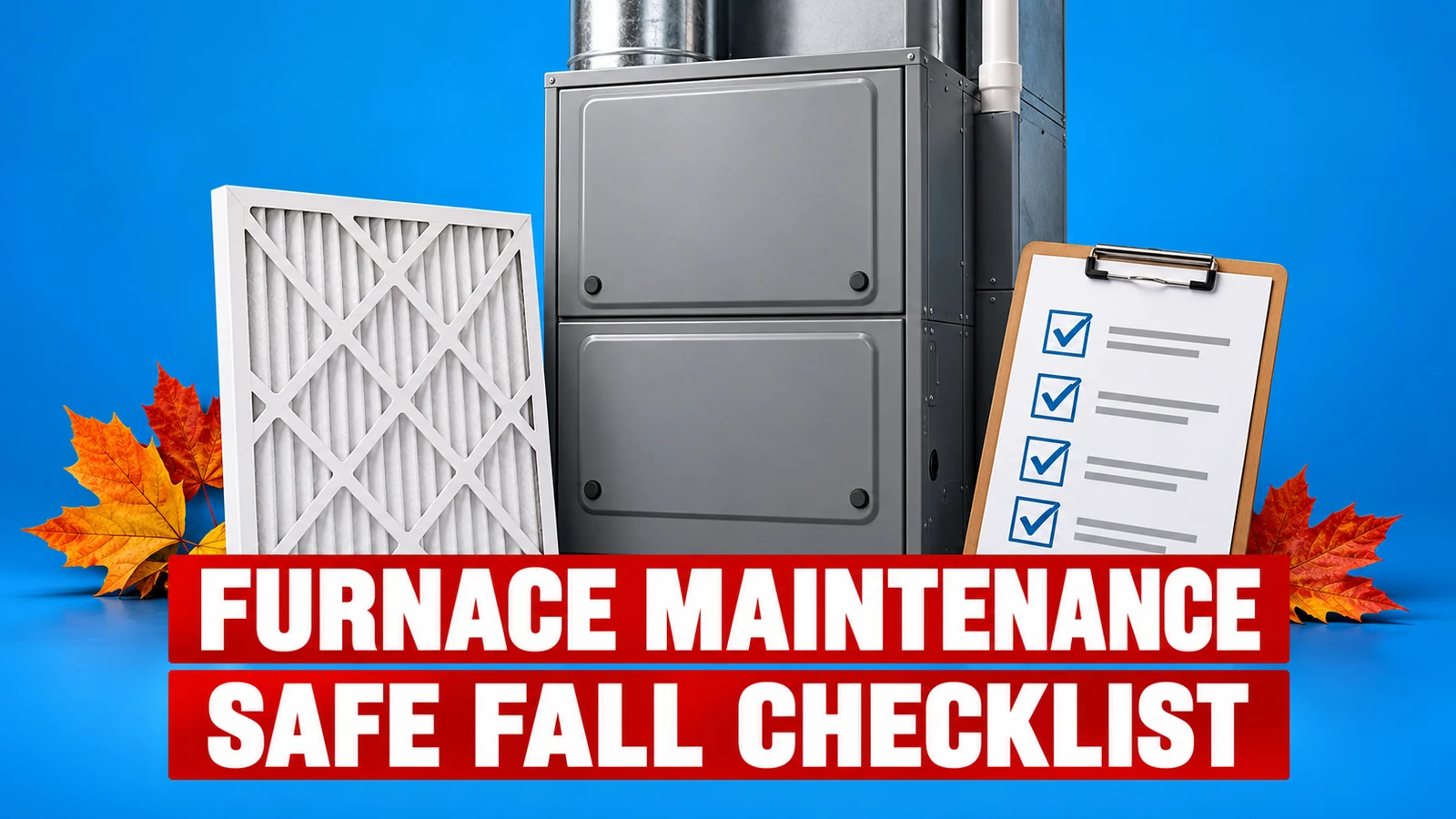
A furnace maintenance checklist is most useful when it separates safe homeowner prep from work for a trained HVAC professional. It is for a furnace that is operating normally and needs seasonal preparation. Oklahoma homeowners can check a few accessible items before heating season without opening the furnace or testing components. This guide leaves combustion, electrical, and vent-system evaluation to a technician.
Emergency—get everyone outside and call 911 first: If a carbon-monoxide alarm sounds, anyone may have CO-exposure symptoms, you smell gas or suspect a leak, or you see sparks, smoke, or fire, stop the checklist. Take people and pets outside, call 911 from outside, account for everyone, and stay out until emergency responders say it is safe. For a gas odor, do not use switches, phones or electronics, flames, or a nearby vehicle while in the affected area. In Oklahoma Natural Gas territory, also call 800-458-4251 from outside, as directed in the utility’s gas-emergency guidance. Never search for the source or restart the furnace. The U.S. Consumer Product Safety Commission (CPSC) says not to ignore a CO alarm or re-enter until emergency responders allow it.
Homeowner checks versus technician work
Safe fall preparation stays at room level, follows the manufacturer’s instructions, and requires no tool or access panel. A professional visit goes further.
| What you can safely check | What a technician should inspect |
|---|---|
| A clearly designated, easy-to-reach filter | Internal cabinet and blower components |
| Open, uncovered supply and return grilles | Airflow performance and safety-control operation |
| Required clearance around the furnace, following its manual | Electrical connections, motors, current, and controls |
| Smoke and CO alarms, following each alarm’s instructions | Burners, ignition, gas pressure, combustion, and heat exchanger |
| A visible exterior termination from ground level—look only | Flue and vent integrity, draft, corrosion, and suspected blockage |
| One ordinary thermostat request for heat | Diagnosis of no heat, shutdowns, odors, noises, or fault codes |
If any item is unclear or would require removing a panel, climbing, reaching into equipment, or touching gas or electrical parts, leave it for service.
Your safe fall furnace maintenance checklist
Complete these checks when there is no emergency sign or active equipment problem. Begin with your system’s instructions, then stay within the homeowner-accessible tasks they permit.
1. Read the furnace owner’s manual first
Find the manual for the correct furnace model and review its homeowner-maintenance section. The U.S. Department of Energy’s consumer guide recommends consulting the owner’s manual and arranging a professional fall furnace check.
The manual should govern filter access, operating settings, clearances, and every owner-permitted task. If it is missing, use model information only when already visible outside the cabinet, then obtain the official manual or ask your HVAC company. Do not remove a panel to find a label.
This is also a good time to schedule professional furnace maintenance before the system is in heavy use. A maintenance appointment is preventive service, not a guarantee against a later breakdown or proof that a particular furnace is safe.
2. Inspect only a clearly accessible filter
Set the system to Off as the manufacturer directs before handling the filter. Inspect it only if it sits in a designated slot or return grille that is easy to reach and intended for homeowner access. Do not remove a furnace panel, defeat a door switch, reach past wiring, or enter an unsafe attic or crawlspace.
If the manual calls for replacement or cleaning, use the specified filter type and size and follow the marked airflow direction. If the location, orientation, or procedure is uncertain, stop and ask a technician. The Off setting here is part of the manufacturer’s filter procedure; it is not permission to perform electrical work.
ENERGY STAR recommends regular filter inspection, but the right service interval depends on the filter, system, home, and manufacturer guidance. A dirty filter can restrict airflow; its condition cannot diagnose a noise, shutdown, no-heat complaint, or other furnace fault.
3. Uncover indoor vents and respect equipment clearances
Walk through the occupied rooms and check reachable supply registers and return grilles. Make sure they are open and not covered by rugs, furniture, curtains, boxes, or stored items. Both the Department of Energy and Carrier’s homeowner guidance advise keeping supply and return airflow paths unobstructed.
At the furnace, visually check that household storage and clutter are kept outside the required clearances. Clearance requirements vary by model, so use the distances in your manual. Persistent weak airflow or uneven comfort calls for professional assessment rather than a deeper homeowner inspection.
4. Test smoke and carbon-monoxide alarms as directed
Use each alarm’s test procedure and replacement guidance. CPSC recommends CO alarms on every level and outside sleeping areas and says to test and replace them according to the alarm manufacturer’s instructions. Its smoke-alarm guidance recommends monthly testing.
An alarm is an added layer of protection, not a furnace inspection. A successful test does not verify combustion, venting, or heat-exchanger condition. If a CO alarm sounds, follow the emergency steps above even when no one feels ill; do not silence it and look for the source.
5. Look at a visible exterior termination from ground level
Some furnaces have intake or exhaust terminations visible outside the home; others do not. From the ground, without touching anything, look for an obviously crushed, damaged, buried, or covered termination.
Do not climb, probe, detach, brush, thaw, tape, seal, clear, or alter a pipe or termination—even if leaves, ice, snow, nesting material, or damage appears to be involved. Call a qualified HVAC professional instead. A ground-level glance cannot establish that the full vent path, combustion process, or draft is safe.
6. Make one ordinary thermostat call for heat
After the other checks, set the thermostat to Heat and choose a reasonable set point above the displayed room temperature. Allow the normal response time described in the system or thermostat manual. Observe from the living area whether heat begins normally.
This is a settings check, not a reset procedure. Do not cycle breakers, manipulate a furnace switch or gas valve, open the cabinet, or make repeated restart attempts. If the furnace does not respond normally, stop. Use the separate furnace-won’t-turn-on guide for safe next steps, or request professional diagnosis.
Why fall is the right time for professional maintenance
ENERGY STAR recommends annual pre-season HVAC checkups and identifies fall as the preferred time for the heating system. Scheduling before sustained cold-weather use gives a technician a practical opportunity to evaluate operation and address model-specific service needs before the furnace carries its seasonal workload.
Professional scope varies by equipment type, fuel, condition, and manufacturer requirements. Depending on the system, trained service may include operating and safety checks plus evaluation of electrical connections, controls, airflow, burners and ignition, combustion, gas components, heat exchanger, blower, condensate components, and venting.
In particular, do not attempt DIY work involving:
- burners, igniters, flame sensors, gas pressure, connections, or valves;
- combustion testing or heat-exchanger evaluation;
- wiring, voltage, current, breakers, capacitors, motors, or controls;
- flue or vent integrity, draft, corrosion, connections, or obstructions;
- internal blower or cabinet cleaning, safety controls, or condensate parts.
Even a thorough visit cannot promise that no future failure will occur. Its value is a trained, system-specific evaluation—not a blanket guarantee or a substitute for repairing a known fault.
When a checklist becomes a repair or replacement decision
Routine maintenance is for a furnace that is operating without an active fault. No heat, repeated shutdowns, a burning odor, water near equipment, an unfamiliar mechanical noise, or a persistent error message needs diagnosis. Skip further checklist attempts and arrange furnace repair. Sparks, smoke, fire, a gas odor, or a CO alarm remains an emergency and follows the stop instructions at the top of this guide.
Age alone does not turn maintenance into replacement. If a diagnosis finds a significant repair, failures are recurring, or the equipment’s reliability is changing, document the finding and compare supported options. Our guide to how long a furnace lasts explains how age, condition, repair history, warranties, and parts availability fit together. Review furnace replacement only when the diagnosis and the furnace’s overall condition make that comparison worthwhile.
Plan your Greater Tulsa fall furnace check
Use the homeowner portion of this furnace maintenance checklist once, record anything unusual, and hand off the technical inspection. Capehart Heating & Cooling is based in Kiefer and serves the greater Tulsa area. The team offers 24/7 HVAC service; call to discuss current scheduling and availability.
For preventive care, start with Capehart’s furnace maintenance service. To request an appointment, book online or call (918) 771-1218. Repairs, maintenance, installation, replacement, and cleaning are individually quoted. For a gas odor, CO alarm or possible exposure, sparks, smoke, or fire, leave and call 911 first rather than contacting Capehart.
Furnace maintenance checklist FAQs
Does this checklist replace an annual furnace tune-up?
No. It covers accessible observations and basic fall readiness. ENERGY STAR and DOE recommend a professional pre-season heating check; internal safety, combustion, electrical, airflow, and vent evaluation require trained service.
How often should I change my furnace filter?
There is no single interval for every home and filter. Inspect and service only the homeowner-accessible filter according to the furnace and filter instructions. Ask a technician if the location, size, direction, or schedule is unclear.
Can I clean the inside of my furnace myself?
Not as part of this homeowner checklist. Leave access panels closed and keep hands, vacuums, brushes, and compressed air out of the cabinet. Internal components and cleaning needs belong in the professional service scope.
Is a working CO alarm proof that my furnace is safe?
No. A CO alarm adds protection but does not inspect the furnace or certify combustion and venting. Test alarms as their manufacturer directs, arrange professional equipment maintenance, and treat every sounding CO alarm as an emergency.
What should I do if the furnace fails the one-time heat check?
Stop after the one ordinary request for heat. Do not use reset sequences or repeatedly cycle the system. Record what happened and request professional diagnosis; use 911 and the applicable emergency response for any gas odor, CO alarm, sparks, smoke, or fire.
Sources
- ENERGY STAR: Maintenance Checklist
- U.S. Department of Energy: Consumer Guide to Home Heating and Cooling
- U.S. Consumer Product Safety Commission: Carbon-Monoxide Questions and Answers
- U.S. Consumer Product Safety Commission: Smoke Alarms—Why, Where, and Which
- Oklahoma Natural Gas: When You Smell Gas
- Carrier: Furnace Troubleshooting Guide
- Trane: Gas Furnace Maintenance