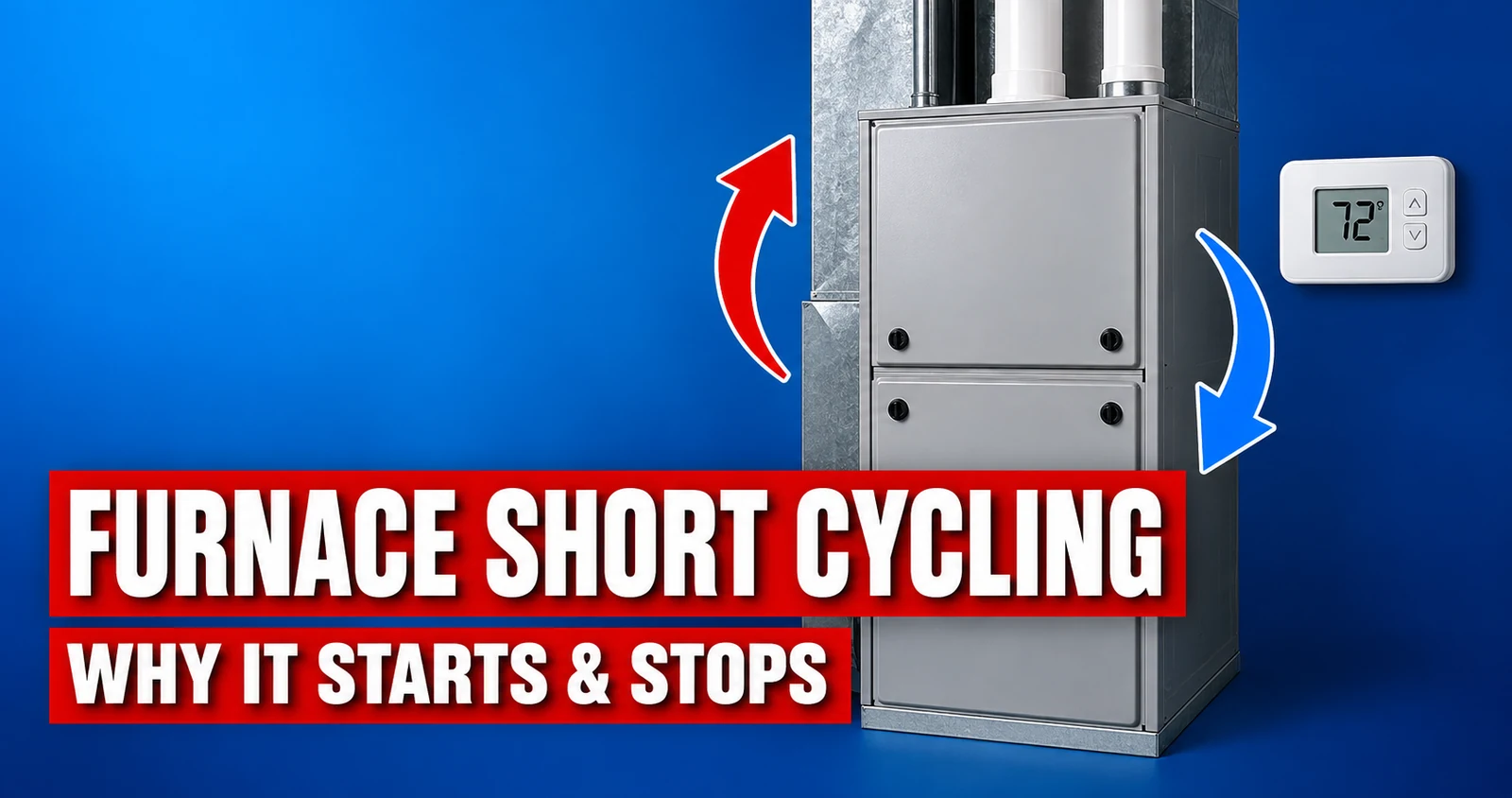
If your furnace keeps turning on and off before the home reaches the thermostat setting, it may be short cycling. A repeated start-stop pattern deserves attention, but it does not identify a failed part by itself. First separate a true interrupted heating cycle from ordinary blower operation, screen for emergency signs, and make only a few low-risk checks at normal household controls.
This guide explains what Tulsa-area homeowners can safely observe, what should be left to an HVAC technician, and when to stop troubleshooting. If the furnace does not start at all, use the separate furnace won’t turn on guide instead.
What furnace short cycling actually looks like
Short cycling usually describes a pattern in which a heating call begins, heat production stops before the thermostat is satisfied, and the system then tries to start again. Carrier’s short-cycling guidance and Trane’s furnace guidance both identify thermostat, airflow, equipment, and sizing issues as possible categories—not conclusions a homeowner can reach from sound or timing alone.
There is no universal number of minutes or cycles per hour that diagnoses the problem. Outdoor temperature, the home’s heat loss, and the way the system is designed all affect operation. Single-stage equipment can sound different from two-stage, modulating, or variable-speed equipment. A new pattern, repeated interruption before the room warms, or failure to maintain comfort is more useful than comparing the system with a generic timer.
Also distinguish the blower from the heating cycle. A thermostat fan set to ON can circulate room-temperature air between heating calls. In other situations, the blower may continue after heat production stops while the equipment cools. Neither observation alone proves furnace short cycling. If air is moving but it never becomes warm, see the furnace blowing cold air guide for the closer symptom match.
| What you notice | What it may tell you | Next step |
|---|---|---|
| The furnace starts, stops before the setpoint is reached, and soon repeats | Possible short-cycling pattern | Complete the safe checks below once |
| The blower runs between heating calls and the thermostat fan shows ON | Fan setting may explain the airflow | Review the normal fan setting |
| The system runs differently during very cold weather or at a lower stage | Load or staging may affect the pattern | Watch whether the home reaches the setpoint |
| The thermostat is blank or unresponsive | The thermostat may be the more relevant symptom | Follow the thermostat troubleshooting guide |
This table sorts observations. It does not diagnose the furnace.
Before any checks: gas, carbon monoxide, smoke, and fire safety
Leave first if there is a gas odor, a carbon monoxide alarm, a smoke alarm, visible smoke or fire, active sparking, or another immediate hazard. Do not touch the thermostat, light switch, appliance, phone, gas valve, meter, or other electrical device while inside. Take people and pets outside, call 911 from a safe location, and contact the local gas utility when gas is suspected. Do not re-enter until emergency responders or the utility say it is safe.
The U.S. Consumer Product Safety Commission’s CO guidance says a sounding CO alarm should never be ignored and advises occupants to move outside, call emergency services, and remain out until responders permit re-entry. Its alarm guidance says to get outside and call 911 when a smoke or CO alarm sounds. Oklahoma Natural Gas tells customers who smell gas to leave immediately and call 911 and the utility from outside. In Oklahoma Natural Gas territory, its listed emergency number is 800-458-4251; other addresses should use their own gas utility.
Short cycling alone does not prove a gas leak, carbon monoxide problem, or cracked heat exchanger. These emergency directions apply when the warning sign itself is present. Emergency responders and the gas utility come before an HVAC appointment.
Three safe checks you can make without opening the furnace
If there is no emergency sign, limit your checks to ordinary controls and items the owner’s manual identifies as user-serviceable. Do not remove a furnace panel, inspect burners, interpret internal codes, reset safety controls, or repeatedly power-cycle the system.
1. Review the visible thermostat settings
From a normal, dry location, confirm that the thermostat is set to HEAT, the requested temperature is above the displayed room temperature, and the fan is set to AUTO rather than ON. Check whether a schedule, hold, vacation mode, or recent setting change explains the behavior. Do not remove the thermostat, alter wiring, enter installer settings, or use a large setpoint change as a test.
2. Check only an accessible, user-serviceable filter
Restricted airflow is one possible contributor to overheating and shutdown. If the owner’s manual identifies a routine filter that can be reached without opening the furnace cabinet or touching internal equipment, first turn the system off using only the manual’s model-specific safe-off procedure. Then follow the manual’s replacement instructions, including specified size and orientation. If the filter location or safe-off procedure is unclear, leave it alone.
A clean filter does not rule out a blower, duct, safety-control, combustion, or other equipment problem. Never open a panel to look for another filter or internal obstruction.
3. Clear ordinary room-side airflow obstructions
Make sure intended supply registers and return grilles in occupied rooms are open and not covered by rugs, furniture, boxes, or drapes. Do not reach into a grille, change hidden dampers, seal ducts, or modify vents. Carrier’s airflow guidance identifies loaded filters and blocked registers as possible restrictions, but persistent cycling after these visible checks still needs diagnosis.
Make each check once. If the pattern continues, stop testing and arrange service rather than forcing repeated heating calls.
Why a furnace may start and stop repeatedly
Several different faults can create a similar start-stop pattern. These categories explain what a technician may investigate; they are not DIY repair steps.
Airflow restriction and overheating protection
If the system cannot move enough air, temperature protection may interrupt heat production while the blower continues to move air. A loaded filter or closed room register is only one possibility. Blower operation, duct restrictions, internal components, and control behavior require on-site testing. Never bypass or repeatedly reset a limit or other safety control.
Ignition, flame-proving, venting, or control problems
On gas furnaces equipped with flame-sensing controls, a missing proof-of-flame signal can cause the gas valve to close after ignition. Carrier notes that ignition, wiring, grounding, gas-supply, combustion, and control issues can produce similar symptoms. That is why a start-stop pattern cannot confirm a dirty flame sensor. Do not open the cabinet, clean or bypass a sensor, relight anything, work on wiring, or inspect a vent or flue.
Thermostat, equipment sizing, or system-design issues
A thermostat problem can interrupt or misread a heating call. Equipment that is not properly matched to the home’s load may also produce an undesirable pattern, but cycle timing alone cannot establish that the furnace is oversized. Thermostat placement, control communication, staging, installation, and load calculations belong in a professional assessment.
When to stop the furnace and call for service
Request professional diagnosis when the repeated start-stop pattern continues after the three safe checks, the home cannot reach or hold the setpoint, the behavior is new or worsening, or there is an unfamiliar sound, odor, or visible alert. The same applies if the heat stops but the blower keeps running repeatedly, or if the furnace needs multiple attempts before warmth reaches the rooms.
When no emergency condition is present and the thermostat is safely accessible, stop creating additional test cycles. Follow the equipment owner’s manual for taking the system out of normal heating operation while arranging service. Do not use the breaker, disconnect, gas valve, cabinet switch, or an internal reset as a troubleshooting method.
A technician may evaluate temperature rise, airflow, blower performance, thermostat communication, safety controls, ignition and flame-proving behavior, venting, combustion, gas supply, wiring, control operation, and system sizing as applicable. Because several categories overlap, replacing or cleaning a guessed part before testing can miss the actual cause or defeat a safety function.
What to observe before the technician arrives
A short, factual description is more useful than a home diagnosis. Note:
- The thermostat mode, fan setting, setpoint, and displayed room temperature.
- Whether warm air begins before the system stops.
- Whether the blower continues after the heat stops.
- Whether the room temperature rises, holds, or falls.
- When the pattern began and whether it changes with outdoor conditions.
- Any message visible on the thermostat without opening equipment.
- Any recent filter, thermostat, or HVAC work.
Do not remove a cover to photograph a component, find an internal code, or inspect the flame. If an emergency sign appears while you are observing the system, leave and follow the emergency guidance above.
Furnace help in Kiefer and the greater Tulsa area
Capehart Heating & Cooling is based in Kiefer and serves the greater Tulsa area. If your furnace starts and stops repeatedly or cannot maintain the thermostat setting, schedule a professional furnace repair assessment. Capehart offers 24/7 HVAC service; availability and response details are confirmed when you contact the team.
The $99 service-call fee covers the visit to assess the problem only. Repairs are not included and are quoted separately. After the active problem is resolved, routine furnace maintenance can support ongoing care, but maintenance is not a substitute for diagnosing current short cycling.
Call 918-771-1218 to describe the pattern and arrange service.
Furnace short-cycling FAQs
Why does my furnace turn on and then shut off?
Possible categories include restricted airflow, thermostat or control problems, an overheating response, ignition or flame-proving trouble, venting or combustion concerns, and equipment sizing. The symptom does not identify the cause; persistent cycling needs on-site diagnosis.
Is every short furnace cycle a problem?
No single cycle length diagnoses a fault. Weather, home heat loss, staging, and equipment design affect operation. Focus on repeated interruption, a changed pattern, and whether the home reaches the thermostat setting.
Why is the fan still running after the heat stops?
The blower may circulate air because the thermostat fan is set to ON, or it may continue while the equipment cools. Continued blower operation alone does not prove short cycling. Repeated loss of heat or falling room temperature should be assessed.
Can I clean the flame sensor myself?
This guide does not recommend it. Similar symptoms can come from several ignition, wiring, gas-supply, combustion, or control issues. Opening the cabinet or cleaning, bypassing, or replacing an internal safety-related component should be left to a qualified technician.
Should I keep resetting a short-cycling furnace?
No. Repeated resets can conceal the pattern without correcting the cause. Make the safe visible checks once, record what happens, and arrange professional service if the furnace still starts and stops repeatedly.