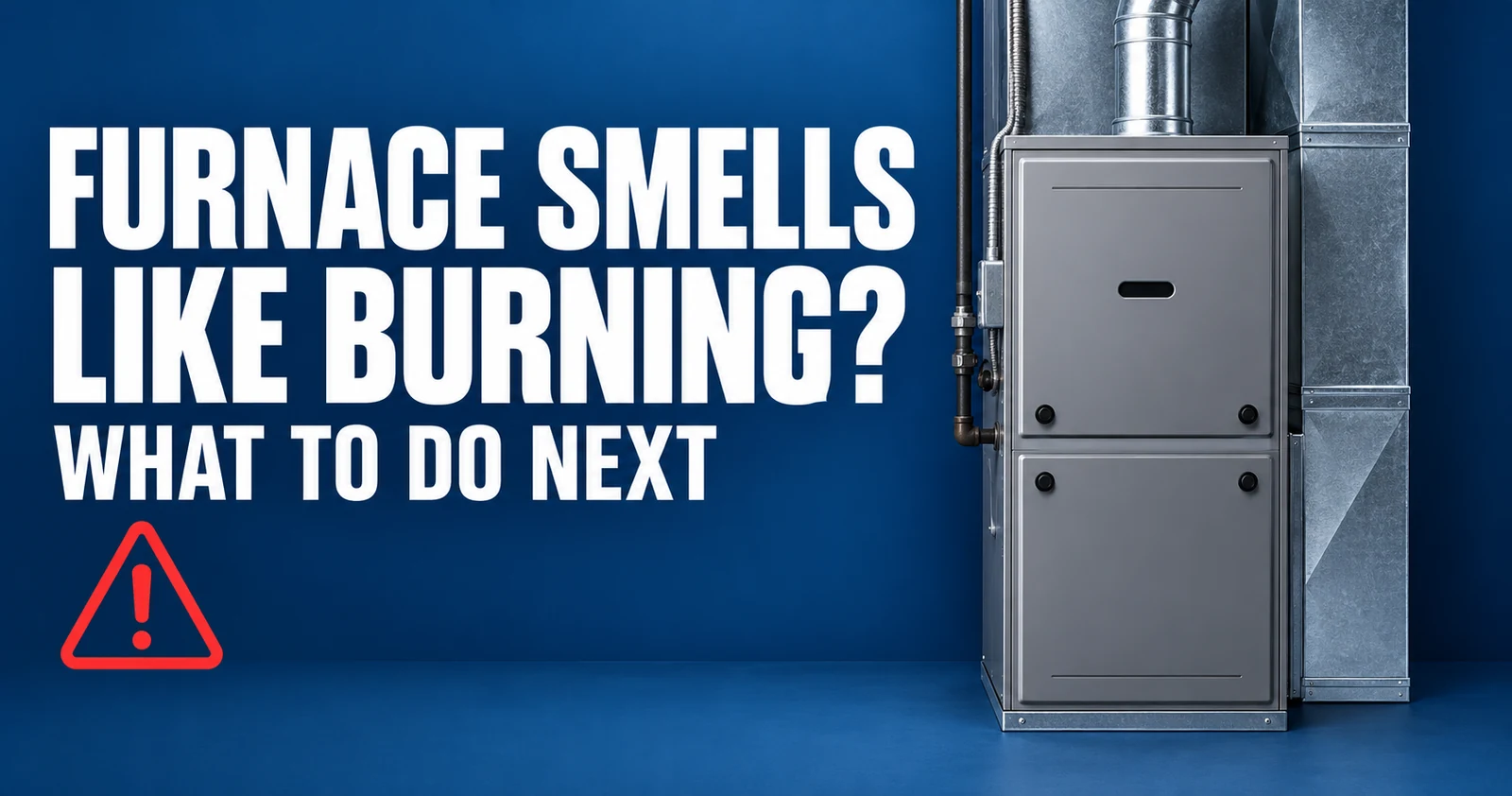
A burning smell from your furnace can be temporary dust only in a narrow situation: it began with the first heat after a long idle period, was faint, and has already clearly faded with no other change—a pattern Carrier describes as possible dust burn-off. A plastic or electrical odor, sulfur or rotten-egg odor, smoke, fire, sparking, or an alarm is not normal. Carbon monoxide (CO) is odorless, so smell cannot confirm or rule it out. Odor also cannot identify a failed part. Do not keep the furnace running to test the smell.
Emergency warning: If you smell gas or sulfur, a CO alarm sounds or exposure is suspected, or you see smoke, fire, or sparking, get everyone and pets outside first. Do not use a phone, thermostat, light switch, electronics, flame, garage-door opener, or nearby vehicle inside or near the suspected area. From outside and away from the building, call 911. For suspected gas, also call the local gas utility. Stay out; do not re-enter until emergency responders or the utility say it is safe.
Oklahoma Natural Gas tells customers to leave immediately and call 911 and the utility from outside if they smell gas. In its service territory, the gas-emergency number is 800-458-4251; elsewhere, call the utility that serves the address. CPSC gives the same leave-first priority for a smoke or CO alarm. Emergency responders and the gas utility come before an HVAC appointment.
What to Do Now
Start with the first row that matches what you notice. These are response categories, not remote diagnoses, and an emergency sign overrides every thermostat or service-booking step.
| What you notice | What it may mean—not prove | Safest next step |
|---|---|---|
| Gas, sulfur, or rotten-egg odor | Possible gas emergency | Leave immediately without operating anything inside or nearby. From a safe location, call 911 and the local gas utility. Stay out. |
| CO alarm or suspected exposure | CO emergency; CO itself has no smell | Move outside to fresh air, call 911, account for everyone, and do not re-enter until responders permit it. |
| Smoke, fire, sparking, or a sounding smoke alarm | Possible fire or electrical emergency | Get everyone outside, call 911 from outside, and stay out. Do not investigate or restart the furnace. |
| Melting plastic, rubber, electrical insulation, or hot-metal odor, with no emergency sign | Possible electrical, mechanical, airflow, or foreign-material problem | Do not keep testing. If the thermostat is safely reachable, select System Off, then request professional assessment. Do not use a breaker or open equipment. |
| Faint dusty or hot-dust odor at the first startup after a long idle period; it has already clearly faded and nothing else changed | Dust warming may explain it, but smell is not proof that the system is safe | Do not run another cycle as a test. If the odor remains, is uncertain, strengthens, returns, or accompanies another change, select System Off at a safely reachable thermostat and arrange service. |
For a nonemergency odor, System Off at the thermostat stops the ordinary heating request; it does not isolate electrical power. Leave electrical isolation and equipment access to a qualified technician. If you are unsure whether the situation is an emergency, leave the area and call 911 from outside.
Why It May Smell Burnt
An odor can help choose a safe response, but it cannot tell you which component—if any—has failed.
Dust after a long break. Dust can settle while heating equipment is idle. When heat starts again, that dust may create a faint hot or dusty odor. The useful distinction is not a stopwatch: the odor had already clearly faded, and there was no gas odor, alarm, smoke, sparking, plastic smell, worsening intensity, or operating change. A dusty label is never an all-clear when other warning signs are present.
Restricted airflow. A loaded filter or another airflow restriction can contribute to abnormal heat or odor, but only testing can show whether airflow is actually involved. Lennox includes restricted airflow among several possible odor categories; that does not make filter handling an appropriate response to an active odor. Leave suspect equipment for the technician.
Plastic or foreign material. A sharp melting-plastic, rubber, or chemical-like odor may involve overheated material or something in the air path. It does not reveal where that material is. Do not approach the suspected source, remove a register, reach into ductwork, or open the furnace to look for it.
Electrical or motor heat. Wiring, a motor, a connection, or another internal part may overheat and produce an electrical, rubber, metallic, or plastic-like odor. Different problems can smell similar, so this is a stop-and-call category rather than a component diagnosis. Smoke, fire, sparking, or an alarm moves it to the emergency path.
Another source. Odors can travel through a home or be drawn into an air-distribution system from another appliance or household source. That possibility still does not justify tracing the smell. A technician can determine whether the furnace is involved. If the odor occurs only while cooling, use the separate AC odor guide after any immediate hazard has been addressed.
Safe Observations
Only make routine observations after ruling out gas or sulfur odor, a CO or smoke alarm, suspected exposure, smoke, fire, and sparking. If any appears, skip this section and leave.
From a normal living area, note what you already know without moving toward the furnace or suspected source:
- Did the odor appear on the first heating call after months off, or during later use?
- Was it noticed in one occupied room or throughout the home?
- Had it already faded, or was it steady, stronger, or returning?
- Did heat output, ordinary airflow, sound, or cycle behavior change at the same time?
- Is a message already visible on a normally used thermostat?
Do not keep the furnace running to collect more evidence. For a persistent or suspect nonemergency odor, use a safely reachable thermostat once to select System Off, then leave it off for assessment. Do not reset the system, cycle a breaker, touch a disconnect or gas valve, open a panel, remove a register, access a filter, inspect venting, or run another test cycle. If the source or safety remains uncertain, step away and report only the observations you already have.
When to Call
Call 911—and the local gas utility when gas is suspected—before calling an HVAC company for any emergency sign in the warning above.
When no emergency sign is present, request professional furnace repair for a plastic, rubber, electrical, hot-metal, melting, persistent, worsening, recurring, or unidentified odor. Call as well when the smell starts after the first seasonal use or occurs with unusual noise, weak or lost heat, or an unexpected shutdown. Continued heat output, a normal thermostat display, or a fading odor is not a complete safety test.
If the odor accompanies repeated early shutdowns, the furnace short-cycling guide explains that separate symptom. Do not create more cycles to confirm it. Sparking, smoke, fire, or an alarm remains an emergency—not an ordinary service call.
What a Technician Checks
On-site assessment connects the odor to measured equipment behavior rather than a guess. Depending on the system and what happened, a qualified technician may evaluate:
- When and where the odor occurs, the equipment model, and the operating mode.
- Filter condition, return and supply airflow, temperature behavior, and safety-limit operation.
- The blower motor, electrical components, wiring, controls, and connections with appropriate test equipment.
- On applicable fuel-burning equipment, the burner, ignition, combustion, heat exchanger, and venting.
- Possible foreign material in the air path, recent installation or repair work, and whether another appliance or household source is responsible.
This list describes professional diagnostic scope, not homeowner test steps. The inspection determines the cause and repair scope; odor alone cannot do that, and no specific finding or repair can be promised before the equipment is assessed.
Can Maintenance Help?
After the active concern has been evaluated and resolved, preventive service may identify airflow, electrical, burner, venting, or cleanliness issues before peak heating demand. The CPSC recommends annual professional inspection of fuel-burning heating systems and related vents, flues, and chimneys.
Maintenance cannot guarantee an odor-free season, and it is not the response to a current gas, smoke, plastic, or electrical odor. Once the system is operating normally, seasonal furnace maintenance can support preventive care.
Furnace Odor FAQs
Is a first-start burning smell normal?
A faint dusty odor may occur when heat starts after a long idle period, but only treat dust as a possibility if the smell has already clearly faded and there is no gas odor, alarm, smoke, sparking, plastic smell, or other change. Do not run the furnace to test that theory.
How long should a dusty smell last?
There is no universal safe time limit. Do not wait a set number of minutes or hours while the furnace runs. If the odor has not already clearly faded, or it strengthens, returns, or comes with another symptom, select System Off at a safely reachable thermostat and request assessment.
Why does my furnace smell like burning plastic?
An electrical or mechanical issue, overheated material, restricted airflow, or foreign material may be involved, but smell cannot identify the cause. With no emergency sign, select System Off at a safely reachable thermostat and call for service. For smoke, fire, sparking, or an alarm, leave and call 911.
Can CO smell like something burning?
No. Carbon monoxide is colorless and odorless. A burning smell neither confirms nor rules out CO. If a CO alarm sounds or exposure is suspected, move everyone outside to fresh air, call 911, account for occupants, and stay out until emergency responders permit re-entry.
Should I turn off a furnace that smells like burning?
For gas or sulfur odor, a CO alarm or suspected exposure, smoke, fire, or sparking, leave first without touching the thermostat. For a persistent plastic, electrical, or unknown odor with no emergency sign, select System Off only if the thermostat is safely reachable, then arrange service.
Need Help With a Furnace Odor?
Capehart Heating & Cooling is based in Kiefer and serves homeowners and property managers throughout the greater Tulsa area. Capehart offers 24/7 HVAC service; contact the team to confirm availability and timing. The $99 service-call fee covers the visit to assess the problem. It is not a flat repair price, and any repair is quoted separately.
If an emergency row applies, call 911 and the gas utility when appropriate before arranging HVAC service.
Sources
- Carrier: Burning Smell in House?
- Lennox: Does Your Heater Smell Like It’s Burning?
- U.S. Consumer Product Safety Commission: Carbon Monoxide Fact Sheet
- U.S. Consumer Product Safety Commission: Alarm and Gas-Leak Safety
- U.S. Consumer Product Safety Commission: Furnace Safety
- Oklahoma Natural Gas: When You Smell Gas
- U.S. Fire Administration: Home Fire Escape Plans